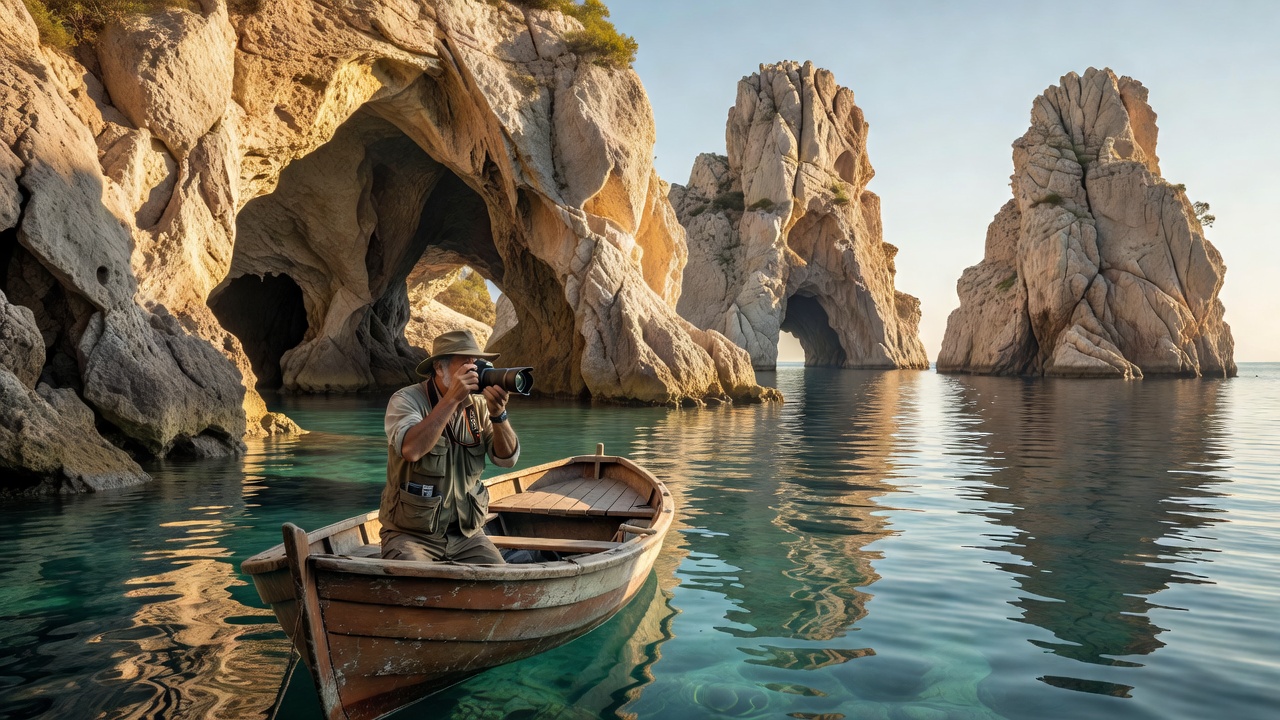
Sea cliffs, hidden coves and lighthouse panoramas that show their best side only to someone looking back at the land.
The shore has its own habits of looking. Viewpoints are built where cars can park, paths can run and railings can be fixed, and so most coastlines are photographed from a handful of identical spots. Step off the land and those habits fall away. The question becomes not "where can I stand?" but "where does this coast make sense?" — and the answer is often a few hundred metres offshore, at a height of two metres above the water.
That low, distant position changes three things. Scale returns, because a cliff seen from below and afar reads as a wall rather than a drop. Relationships appear, because arches, stacks and headlands line up against each other in ways no single clifftop can reveal. And the sea itself enters the frame as a foreground — texture, reflection, a line of surf — instead of a distant blur.
What follows is a journal of places where that shift matters. Each passage describes the photograph, not a route. Treat them as inspiration, and leave the questions of approach, depth and anchoring to current charts, pilot books and the person responsible for the boat.
Normandy, France · Côte d'Albâtre
Étretat and the Alabaster Coast
The chalk of the Côte d'Albâtre runs for over a hundred kilometres, but Étretat concentrates it into three famous forms: the Porte d'Amont, the Porte d'Aval and the needle of the Aiguille. From offshore to the west, the Aiguille sits inside the arch's silhouette, and on a clear evening the white chalk turns honey-coloured. The English Channel's tidal streams are strong here; this is a view for neap tides and settled forecasts, decided locally.
Algarve, Portugal · Lagos
Ponta da Piedade
The sandstone stacks below the Ponta da Piedade lighthouse are a maze of grottoes, natural bridges and pillars. A small boat lets you photograph light coming through the arches in the morning, when the sun is east and low. The rock's warm ochre responds well to slight underexposure; keep the highlights on sunlit faces and let the caves fall dark.
Corsica, France · Bonifacio
The white walls of Bonifacio
The old town of Bonifacio stands on limestone cliffs that overhang the sea, eroded into horizontal bands. From the water the houses appear to grow from the rock itself. The contrast between pale stone and dark water is extreme, so expose for the cliff and accept black shadows at its base. The Strait of Bonifacio is a protected area with traffic rules; its winds can rise quickly.
Water-level framing turns an arch into a window. The lower you sit, the more sky fills the opening.
Kauai, Hawaii · Nā Pali Coast
Nā Pali from the Pacific
Much of the Nā Pali Coast cannot be reached by road, and its fluted green ridges are best known from the sea and air. Summer usually brings calmer water to the north shore; winter swell can make it unworkable. Licensed tour operators run this coast regularly, which is often the sensible way for a visiting photographer to see it.
Provence, France · Calanques
The calanques of Marseille and Cassis
Narrow fjord-like inlets such as En-Vau and Sormiou cut into white limestone. Morning light enters the deeper calanques only for a short window, and the pale seabed lifts the colour of shallow water. The area is a national park, with zones where anchoring and motor traffic are limited.
Zakynthos, Greece · Navagio
Shipwreck Beach, seen rather than visited
The rusting wreck in its white-walled cove is one of the most photographed beaches in Greece. Rockfalls have led to restrictions on landing and approach in recent years. Seen from a respectful distance offshore, the cove still makes a strong frame; whether you can go closer is a question for current local rules.
The water does not grant access. It only shows you what access might look like.
— From our field notebook, Corsica
Lighthouses that stand in the sea
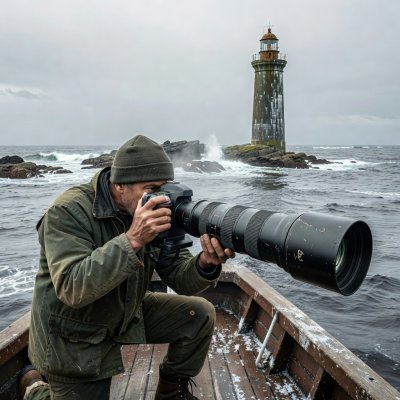
Few subjects reward the waterborne photographer like an offshore lighthouse. La Jument, off the Breton island of Ouessant, became famous through Jean Guichard's photograph of a keeper at the door as a wave broke around the tower. The Fastnet Rock off southern Ireland and Bishop Rock west of the Isles of Scilly are similarly isolated. These towers stand where they do because the water is dangerous; the photograph belongs to a long lens and a calm day, never to a close pass.
Next: the light that makes these places
Orientation decides when each viewpoint comes alive.
We use cookies We use necessary cookies to run the site and, with your consent, optional ones to measure visits. You can change this at any time. Read more